
What’s Real Core Strength?
February 5th, 2009 · by admin · Filed Under: Uncategorized
When I was in my teenage years I used to do all the crunches in the world and did every single “angle” of an exercise to hit the abs and get that impressive six- pack. Not only did I realize that this was not the way to a set of six pack abs but it definitely didn’t improve my on court performance or make me stronger at any lifts.
First question I want to ask you, is do you have a strong core? How do you know, because you have ripped abs? Is it because you do thousands of crunches every week? Or maybe you can hold a plank for a minute? Well, I’m sorry to tell you that’s not going to do it and even though people with a strong core may have six-pack abs and hold a plank for a minute, it is definitely not what determines it.
It actually all starts with the misconception of what muscles belong to the “core”. Most people believe it is just the abdominals, or in some cases, the abs and lower back. The muscles that are all important when we talk about the core are Erector Spinae, Rectus Abdominis, Lattissimus Dorsi, Internal Obliques, External Obliques, Transverse Abdominis, Multifidus, Hip Complex, TFL, Rectus Femoris and the gluteals (maximus, medius and minimus). A little more than just the abs!

Chain Sit Ups
What compelled me to write this post was having a trial training session with a couple of guys that were lean and had a good amount of muscle with visible abs, but couldn’t hold a plank for 30 seconds, let alone a side plank or something a little more advanced. Even when we did a kettlebell front squat with light loads they were unable to hold that posture as their core wasn’t strong or conditioned enough. The craziest part is that these guys were MMA fighters! Without touching on their skill level, I will go ahead and say that they may be in trouble for their next fight if they do not get on a good strength and conditioning program and focus on improving their core strength (also specific to their sport).
So what steps should you take to create a trunk that can stabilize, transfer, absorb and produce a lot of force/power.
Before I move on, let’s just get one thing clear, abdominal hollowing is not the way to go if you want to create a solid functional core. Do not attempt to test this theory and prove me wrong by squatting or dead lifting a bunch of wheels while hollowing, as there is a good chance you will get crushed and the only thing you will achieve is a large number of hits on youtube (if you film it that is). Save the hollowing for the Pilates class and listen on.
Bracing is the way to go when you want to have the most stable core as possible. To create as much intra abdominal pressure as possible you should push your abdominals outward and create muscular tension and a bracing effect (hence why it called “bracing”). So when you lift make sure you brace and not hollow, even if the sexy Pilates instructor told you so!
We should train the core in different ways but it’s important to asses where you are and to not get ahead of yourself. What I mean by that is trying to do advanced exercises when you can’t even pass the basic tests (plank hold, push ups, bird dog, etc…). This is what I see most athletes doing and because of their lack of core strength they just end up compensating with other muscles, reinforcing a improper movement pattern, posture, etc.
So here is how I look at the core progressions. We should progress from ISOLATION to INTEGRATION, from PATTERNED to RANDOM and also increase the complexity of the exercises. I like to follow Smitty’s progressions from his Combat Core e-book (a must read) that follow categories 1-4.
Not on the list but a great for resisting rotation
|
CATEGORY 1 |
CATEGORY 2 |
CATEGORY 3 |
CATEGORY 4 |
|||||
|
Upper/Lower STATIC |
Upper STATIC Lower MOTION |
Upper MOTION Lower STATIC |
Upper MOTION Lower MOTION |
|||||
|
Planks |
Supermans |
Reverse Hyper |
Suitcase Deadlifts |
Standing Cable/Band Crunches |
Med Ball Slams |
Compound Strength Movements |
Speed & Agility Training |
|
|
Bird dogs |
Bridges |
Zercher Lifts |
Overhead Lock Out Walks |
Tornado Ball |
Back Extensions |
Rotational Movements |
Sport Specific Mov. |
|
|
Static Reverse Hypers |
Static Back Extensions |
Core Statics |
Unilateral Training |
Windmills |
Side Bends |
Practice |
Game Time |
|
|
Cross Banded Supermans |
Birddogs w/ Agitation |
Feet attached Ab Wheel |
Hanging Leg Lifts |
Back Extension Med Ball Drops |
Decline Med Ball Throws |
|
|
|
The main things is not starting very complex exercises when you base level of core strength is on key with a 70 hour work week computer guy that only runs long distance and does 500 crunches a day, yet you feel that you should be doing a full abs wheel rollout. Just don’t go on any forum and ask why your lower back is killing you even though you did an abs exercise.
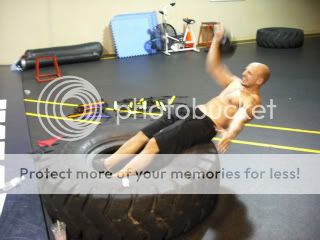
No, not a beginner exercise…
You’re an athlete and there are many things that are important but you better believe you are going to suck on the court/field if you do not have a solid “core”. If by some chance you are physically gifted and you can hide your weakness then it’s only a matter of time before you get injured.
Don’t skip the basics and trump your ego, while you’re at it start doing full parallel squats and cut down and stop doing 30 sets of chest exercises per workout.
What’s your opinion on training the core? The comments section should be full because I’ve opened your eyes or you have a tip or exercise I didn’t mention (let me know if you want to get some more good core exercises in all categories).


 Comments RSS




February 10th, 2009 at 7:31 am
As a cyclist, core strength will mean that my legs give out long before my back does on a 100 mile ride.
March 9th, 2009 at 12:32 pm
How do you perform Cross Banded Supermans?
March 11th, 2009 at 1:35 am
Scott,
I will try to put a picture or video on the blog or youtube site so that you can see it.
June 4th, 2009 at 10:18 am
Doesn’t it take up a lot of time to keep your blog so interesting ?